Warehouse photos: what EastGoBuy checks, and what is left to you
Your items wait in China while you look at their photos. This page covers what the check includes, how to read the pictures fast, and how long they can wait.
Checked and updated October 22, 2026
An eye check, not a lab test
When your item reaches EastGoBuy’s warehouse, staff register it, check it and take QC photos (quality check pictures) so you can see it before it leaves China. EastGoBuy lists what you can check from them: appearance, colour, quantity, packaging and other visible details. The Procurement Agent Disclaimer (article 7628) and section 6 of the terms draw the line: ordinary inspection is not professional testing, and it may miss hidden defects, inner structure and how electronics perform. Photos may not reproduce colour perfectly either.
How many photos are free is not published. Extra custom photos are a paid option whose price shows inside the app.
Six looks at every photo set, in this order
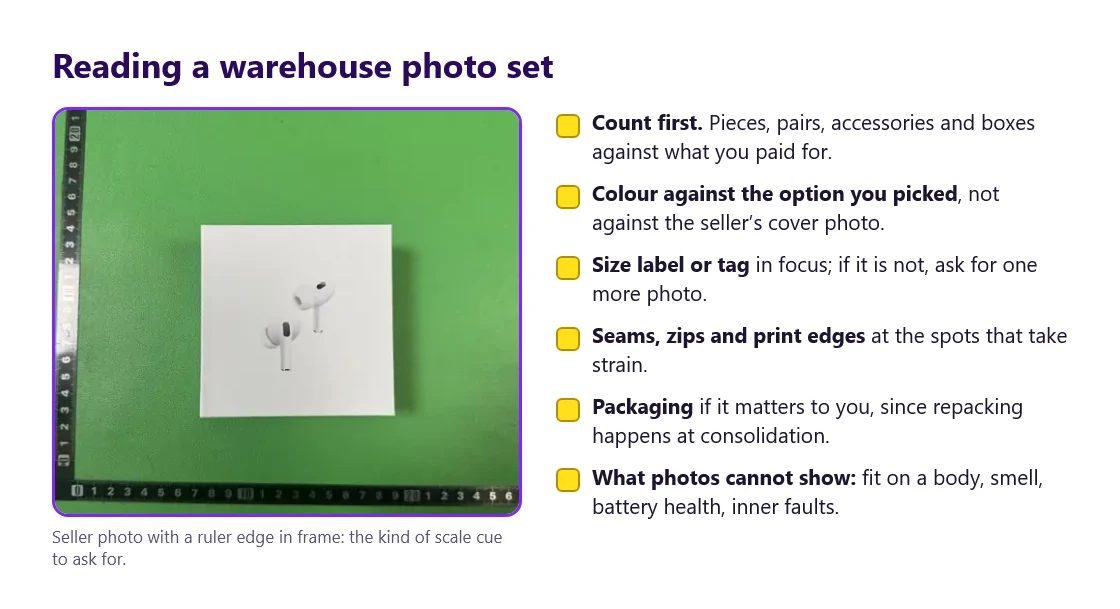
Most problems that photos can catch are caught in the first thirty seconds, if you look in the right order. Our QC checklist:
- Count. Pieces, pairs, accessories and boxes against what you paid for. Multi-packs are where counts go wrong.
- Match the option. Compare with the colour and size you picked from the menu, not with the seller’s cover photo.
- Read the label. The size tag should be legible. If it is not, ask for one more photo of it.
- Look at stress points. Seams at the shoulder and crotch, zip ends, sole edges, strap anchors, clasp hinges.
- Check print and embroidery edges. Wobbly outlines are easier to spot zoomed in than at full view.
- Note what photos cannot show. Fit, smell, battery health, sound. Those you only learn at home.
Green light, red light, and asking for one more photo
Buyers abbreviate the decision as GL (green light: keep it and ship) or RL (red light: return or exchange). With EastGoBuy, a red light means asking customer service to deal with the seller. The disclaimer says EastGoBuy will help communicate about wrong items, missing stock and similar problems “within a reasonable range”, and that the result depends on the seller and the marketplace’s rules. Returns inside China can take a while; the storage clock keeps running for everything else in your warehouse space.
Raise problems before you pay for the parcel line. After the parcel has gone to the carrier, the terms treat most refund requests as change of mind.
Ninety days, a hundred, or unlimited
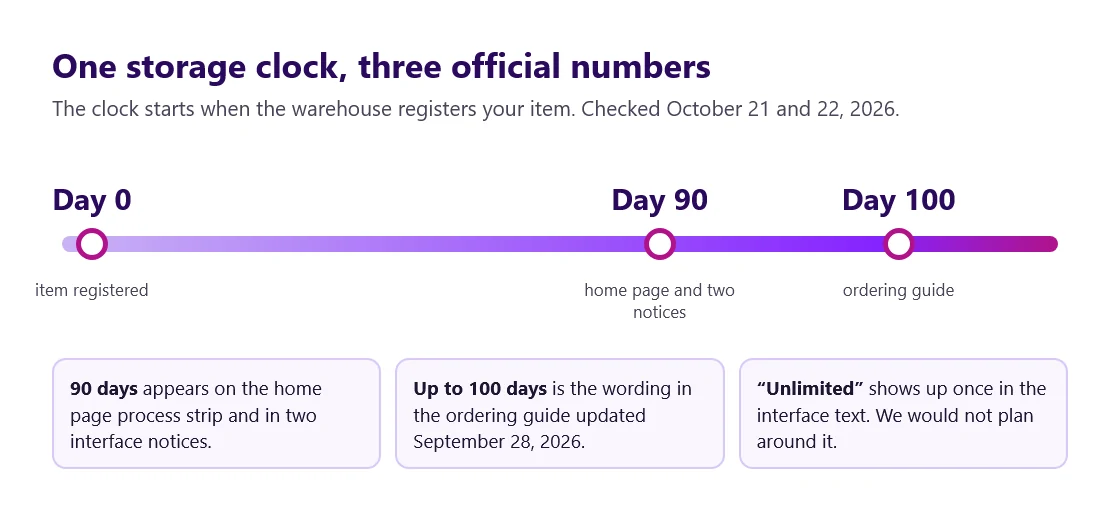
Free storage starts when the warehouse registers an item. How long it lasts depends on which official page you read: up to 100 days for standard parcels in the complete ordering guide, 90 days on the home page process strip and in two interface messages, and “Unlimited” in one interface string. Storage charges after the free period are mentioned in the terms but no rate is published.
Plan around 90 days from the earliest arrival in your parcel. If one seller is slow, ship what has arrived and send the late item later; two small parcels can still cost less than paying storage on a whole haul.
Consolidation, repacking and protecting fragile things
Consolidation means the warehouse puts several orders into one box. You select the items, request it, and the parcel is weighed afterwards. The Getting Started guide lists inspection, photos, consolidation and repackaging as the warehouse services you choose as needed. Repacking is where you can ask for bulky shoe boxes to be dropped, or for extra padding around figures and model cars.
Repacking trades protection against size. A box that grows past 40 cm on any side moves EMS lines onto volumetric billing, so ask for padding where it matters and compression where it does not.